Freemasonry is often described as old, but that can be a little unhelpful on its own. People sometimes ask where it began, expecting a simple answer with a single date, founder or place. The honest answer is more interesting than that.
Freemasonry did not appear fully formed in one moment. It developed over time, drawing on the language, tools and organisation of working stonemasons, then gradually becoming the moral and fraternal society we know today.
That is why Freemasons still speak of the Craft. The word connects modern Freemasonry with the older world of skilled builders, apprentices, masters, lodges and tools. The point is not that modern Freemasons are builders in the ordinary trade sense. The point is that the old building craft provided a strong and practical language for teaching character, conduct and personal responsibility.
The working roots of Freemasonry
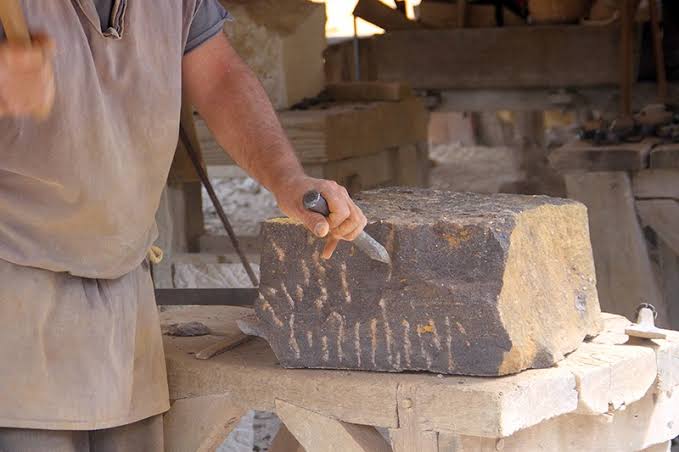
The most widely accepted view among Masonic historians is that Freemasonry developed from the medieval stonemasons who built castles, cathedrals and other major buildings. These men needed skill, discipline and trust. Their work often took them from one place to another, and they belonged to organised groups that helped regulate their trade.
In that setting, a lodge was not first of all a symbolic room. It was connected with the working life of masons. It could be a place where tools were stored, plans were discussed, apprentices learned, and men connected with the building trade gathered.
Over time, the language of building took on a wider meaning. A square could speak of fairness. A level could speak of equality. A plumb rule could speak of upright conduct. These were ordinary working tools, but they also became a way of teaching moral lessons in a memorable form.
From operative to speculative Masonry
A useful distinction is often made between operative and speculative Masonry.
Operative masons were working stonemasons. They physically cut, shaped and set stone. Their work required training, skill and practical knowledge.
Speculative Freemasonry, which is the form known today, uses the language and tools of masonry to teach moral and personal lessons. Instead of shaping stone, the emphasis is on shaping character. Instead of building a cathedral, the focus is on building a better life, better habits and better relationships.
That change did not happen overnight. It seems to have been gradual. Men who were not working stonemasons began to be admitted into lodges. The old trade organisation slowly became something broader: a fraternity concerned with morality, friendship, learning, charity and self-improvement.
The early records
One reason the early history of Freemasonry can be difficult to explain is that the evidence is uneven. Some things are well recorded. Other parts are debated by historians.
Scotland is especially important because of its early Masonic records. The Schaw Statutes of 1598 and 1599 set out rules for the organisation of stonemasons in Scotland, including requirements around lodge records and the regulation of the craft. Records connected with Scottish lodges give us some of the clearest surviving evidence of early organised Masonry.
England also has important early references, and by the seventeenth century we see examples of men being accepted into Masonic circles who were not simply operative stonemasons. This helps explain how Freemasonry moved from a trade setting into a more symbolic and philosophical form.
Even so, it is wise to be careful. Freemasonry’s early history is not helped by exaggerated claims or romantic myths. We do not need to pretend that every detail is known. The real history is strong enough without overstatement.
The formation of the first Grand Lodge
A major turning point came in London in 1717. On St John’s Day, 24 June 1717, four London lodges met at the Goose and Gridiron Tavern and formed the first Grand Lodge. This was important because it helped organise lodges under a wider structure.
In 1723, the Constitutions of the Free-Masons were published. These helped set out rules and principles for the Craft and gave Freemasonry a more formal public shape. From there, organised Freemasonry spread more widely, first through Britain and Ireland, then across Europe and into many parts of the world.
This is why 1717 is often treated as the beginning of modern organised Freemasonry, even though the roots of the Craft are older.
Freemasonry in New Zealand
Freemasonry reached New Zealand in the nineteenth century. The first Masonic activity here belongs to the early colonial period, and Freemasonry grew as settlements developed. Lodges became part of local community life in towns and cities throughout the country.
In 1890, many lodges that had been working under English, Irish and Scottish authority came together to form what is now known as Freemasons New Zealand.
That broader New Zealand story eventually includes our own local history here in Hamilton. Lodge Tawhiri No. 166 was established in 1909, at a time when Hamilton and Frankton were growing and changing. Like many lodges, its story belongs not only to Freemasonry as a worldwide movement, but also to the ordinary life of a local community.
Why the origins still matter
It might be tempting to see all of this as simply history. But the origins of Freemasonry still help explain what a lodge is today.
A lodge is not just a meeting. It is a place where men gather with a shared standard of conduct. It has structure, memory and continuity. It values careful work, not only in ceremony, but in how members treat each other and carry themselves in daily life.
The old language of building still matters because it is practical. Freemasonry asks a man to think about what he is building in himself. Is he honest? Is he dependable? Does he treat others fairly? Is he willing to learn? Is he useful to his family, his lodge and his community?
Those are not old questions. They are very current ones.
A living Craft
The Craft began with builders, but it did not remain only with buildings. It became a way for men to meet, learn, serve and improve themselves in company with others.
For someone in Hamilton or the Waikato who is curious about Freemasonry, the history is worth knowing because it gives context. Freemasonry is not a passing club or a recent invention. It is a long-standing tradition that has adapted across centuries while keeping a steady concern for character, friendship, charity and service.
At Lodge Tawhiri No. 166, we are one small part of that much wider story. We inherit something old, but we practise it locally, among men who live, work and serve in this community.
If you are interested in learning more about Freemasonry in Hamilton, you are welcome to make an enquiry, ask questions, and take your time. A good beginning is simply a conversation.